Showing posts with label Montana stream access law. Show all posts

Tuesday, September 1, 2015

The nuances of Montana's Stream Access Law

(Originally published in the Montana Sporting Journal, Winter 2014)
Hike, fish and be happy.

Enter a Montana river from a public place and stay within its high-water marks – it's the foundation of Montana's stream access law. That access is one of the biggest reasons Montana is world-renowned for trout fishing.

The law is far from cut and dried, however - it's definitions and descriptions are often vague and open to interpretation. If you fish often enough, you'll encounter a protective landowner. But if you understand the law – and its intricacies – you'll be able to stand your ground and hopefully continue that day's trouting.

The Ruby River's Seyler Lane bridge.
The most important thing is that you always follow the rules and stay within the fine lines called high-water marks. To be fair, there isn't an angler who's never stepped out of bounds due to fishing zeal or difficult conditions, myself included (which is not to excuse it, rather it's to be forthright about it). But river users should try to minimize that, not only because it's the law, and not only so you can defend yourself in good faith, but because careless anglers give us all bad names and add fuel to the perennial fire that tries to burn Montana's stream access down. 

First off, the definition of "high-water mark" should be understood. Fish, Wildlife and Park's Stream Access in Montana brochure describes it as "the line that water impresses on land by covering it for sufficient time to cause different characteristics below the line, such as deprivation of the soil of substantially all its terrestrial vegetation..." and I wouldn't dare deviate from that. And it's "ordinary" high-water mark meaning normal-flow mark, not "annual", meaning run-off mark. And it's not within 10 feet, nor two feet (both of which I've heard anglers say), it's within it.

But there are caveats about which many anglers and landowners seem oblivious.

The easily recognizable signs posted on Ted Turner's land. Fair enough. 
One oft-overlooked aspect is that notice denying entry to private land must be posted. From the brochure: "...a member of the public has the privilege to enter or remain on private land by the explicit permission of the landowner or his agent or by the failure of the landowner to post notice denying entry onto the land. The landowner may revoke the permission by personal communication." I warn against taking advantage of this, but those are the law-maker's words.

That notice must consist of "written notice or by ... painting a post, structure or natural object with at least 50 square inches of fluorescent orange paint. In the case of a metal fencepost, the entire post must be painted. This notice must be placed at each outer gate and all normal points of access to the property and wherever a stream crosses an outer boundary line."

Some other details:
·         The law does not address lakes.
·         A no-trespassing sign at a public-road bridge is notice of private property, but does not mean anglers cannot access that stream there (despite the potential intent of whomever posted it within the road easement).
·         River users may portage around man-made obstructions (like fences, irrigation equipment or junked appliances/vehicles) in the least intrusive manner possible but does not address natural barriers, leaving such instances open to interpretation.
·         Not every public-road bridge is always fair game for access. The Seyler Lane bridge on the Ruby River goes back and forth, pending the direction of the judicial winds.

Conflicts often occur on seldom waded drainages where ranchers aren't used to seeing strangers. These places can be desirable fishing holes since they get little pressure.

I've had on-stream conflicts from Darlington Ditch to the Ruby River to the upper Madison to Mitchell Slough. I've seen guns brandished, and sheriffs called. I've also had many congenial conversations with hospitable locals who care more about how the fishing is than why you think you have the right to be there.

Mitchell Slough: We caught fish, but also caught an earful. 
If challenged, it's important to remain respectful and cool, even if you're confronted with a firearm. Calmly explain that you entered legally, and that you have remained within the high-water marks the entire time (and be sure to have done so). Inquire about what evidence they have (some claim to have trail cams at bridges, etc.), and explain the law. Some anglers carry a copy of the law verbatim as defense. Always try to deescalate, and don't argue too long.

Don't be surprised to find neighborly nepotism favoring the landowner if a sheriff's department is called. In such a case, I recommend that you concede but consider writing letters to the appropriate parties. The Public Lands Water Access Foundation out of Billings takes on these cases, and county commissioners sometimes take an interest.

So go find a map's blue line and confidently enter it from a legal place. Search for likely holding water, lay down a gentle cast, mend well, set, and fish without fear.

Wednesday, October 24, 2012

Stand thy ground

Not positive what it is, but I suspect it's that I don't shy away from notorious places (Mitchell Slough, the Ruby River, Ted Turner's properties, etc.). I'll even admit I sometimes enjoy a good ranch-hand/landowner encounter fishing within Montana's high-water marks, but most often it's a shit-show that can ruin a good day.

I've had two so run-ins so far this year (one with multiple encounters), and have had a good number over the years. They're often confrontational and angry - it's always a big "here we go again" moment when I see someone on their way.

But since I fish these places, it's important to be sure that when approached I am doing things legally and I am armed with knowledge. I encourage everyone to patronize any fishing spot you've heard is patrolled, but know the law (for the record, it's not 10 feet nor two feet - both of which I've heard anglers say - it's WITHIN the high-water mark). The enemy wins when anglers avoid.

Some tips for such situations:
  • Know the law and be within it. Be able to explain the law accurately showing that you are not ignorant and/or wrong (click here for a primer).
  • Be polite but firm, and try to deescalate the situation. 
  • If the Napoleon-complexed wiener won't let it go, it might be best to take off for the day. Maintain, however, that you are in the right and come back another day.
  • Avoid taking photos, tempting as it might be, of the confronter. This will definitely escalate tensions.
  • If any threat is levied or weapon brandished, get the eff out and notify the authorities. 
It's easier to avoid these places sometimes, but there's often decent fishing to be had where others fail to go. For good fishing and defense of our rights, go fish.


Thursday, February 10, 2011

HB 309 - onto the Senate

Montana House Bill 309 passed third reading in the house - it even picked up a couple votes this go-round passing 57-43. It's up to the senate now, but my man Kendall Van Dyke thinks he can rally support to end it. Here's hoping - in the meantime, e-mail your senators! Find yours here.

Wednesday, February 9, 2011

HB 309 (limiting stream access) passes House


Montana House Bill 309 (redefining irrigation ditches, or limiting stream access) passed the house of representatives this afternoon by a 55-44 vote. I'm not totally sure (didn't pay attention to my school house rock) but I think from here it goes to the senate, then to the governor. My representative, whom I e-mailed more than once, voted yes. He will be getting another e-mail.

For more on the details, read this Montana Standard (Butte, Mont.) article.

Sunday, February 6, 2011

HB 309-Limiting Stream Access (Here we go again)

So the 2011 attempt by Montana legislators to limit/remove stream access is here  - HB 309.

Click here for the pdf of the bill.

More details: 
http://www.missoulademocrats.org/HB%20309

Chi Wulff

They keep trying and they keep failing. But they will always try so those in favor of our current stream access law must remain vigilant.

Sunday, November 28, 2010

Darlington Bitch

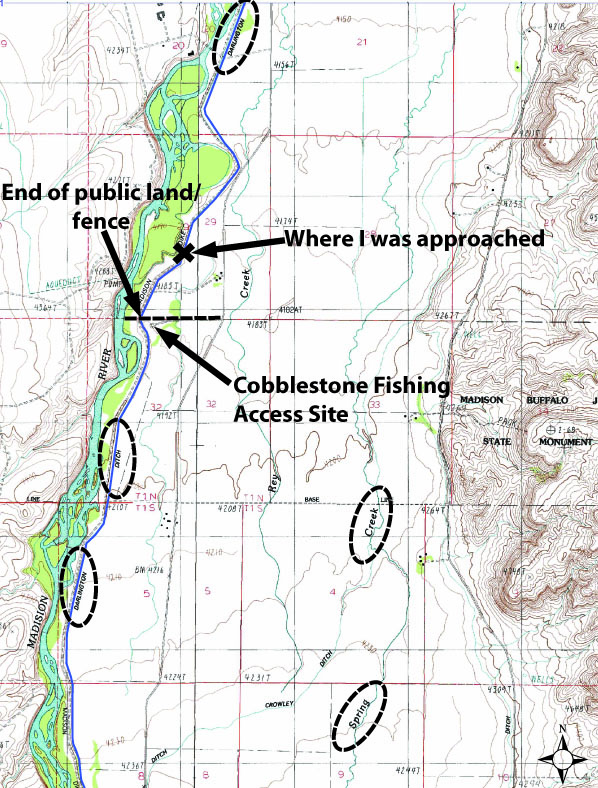
I suspected I was in for a large dose of rubbish as the gray Ford Explorer pulled up along the levee.
"Do you know where you are?" the man asked.
"Darlington Ditch," I responded.
"No, this is not Darlington Ditch. This is Spring Creek."
"Really."
"Yes. And you are trespassing. This is the Rice Ranch."
"No, I'm not. I'm within the high-water mark on a natural waterway."
"Did you cross that fence with the signs?"
"Yes."
"Then you are trespassing."
"No, I'm not. I have stayed within the high-water mark at all points. I know I'm on private property, but I have a right to be here."
"On the river, that's how it works (pointing to the nearby Madison River). But not here."
"Is this a natural waterway?"
"Partly."
...(standoff)...
"Look sir, I will get outta here, but I am not trespassing."
"That's all I ask."
Click to enlarge
It might be easier to let it go, but then ignorant harassers win. I knew I had a right to be there, it was obvious that I was in fact on Darlington Ditch as it was named on a sign just upstream (which didn't ultimately matter - anglers have a right to be there no matter what it's called), but he wasn't about to let it go. The Rice Ranch will be getting a letter from me explaining: that that particular creek is Darlington Ditch; the Montana stream access law; the fishing regulations on Darlington; and that I will see them again soon. I will be back with cell phone in hand, and will get Gallatin County's finest involved if necessary.

The creek itself is intriguing. The vast majority of the water is about 6 inches deep, with a slot here and there that gets to about 2.5 feet deep. It's very mucky in places (I fell through some ice into waist-deep black-tar sludge), and very weedy in true spring-creek fashion. There are a few tailouts, but eventually it turns into a slow, placid, featureless lake. There is a nice blurb about Darlington Ditch in the current Montana Sporting Journal in the "Spring Creek Tour" article.