Thursday, January 27, 2011

More from Costa Rica

More pics from my Costa Rica trip. Enjoy!


The runway in Quepos where my flight from San Jose landed.
Ribs, plantain and yucca at Coki's. Delish. It used to have a dirt floor, leaf roof, and the meat was cooked on a bed spring over a fire pit. You'll need to ask a local how to get there, though.
Some kind of crazy spider. I think it's called a spiny orb-weaver.
About ready to zip down the line....

Zip-line canopy tour.
Rio Canas, two days before we fished it. Good shape.
Rio Canas, two days before we fished it.
Rio Canas, after a night's rain, the day we fished it.
There are bugs in Costa Rican rivers.
Leaf-cutter ants.
Ever hear of a Daihatsu BeGo? The roof leaked profusely when it rained.
One of the many stray dogs around Quepos.
Great kiskadee. Far from the prettiest bird in Costa Rica, but not bad.

Groove-billed ani?

Brown pelican

Brown pelican, feeding.
Ghost crab on the beach at Manuel Antonio.

Ghost crab on the beach at Manuel Antonio.
Squirrel monkeys raiding a construction truck for some sort of unidentified food.

Squirrel monkeys

Squirrel monkeys
The best sangria in Costa Rica can be had at Ronny's.
The view from Ronny's. It's apparently a great place to go to catch a sunset, but it was cloudy both times I ate there. Odd for the dry season.
A beach at Manuel Antonio.
Three-toed sloth.
Two-toed sloth.

Female iguana, Manuel Antonio

One of the Costa Rican-brewed beers. My favorite.

Sunday, January 23, 2011

Pure Life on the Rich Coast

 I returned yesterday from a trip to Quepos, Costa Rica. I was visiting a friend, but also sightseeing and of course fishing. In the interest of laziness, I'll just include my journal entry from the day we went fishing.

Justin, the owner of Pez Rey, our guide service, picked us up at 6:30am sharp and we boarded the boat by 6:45. We headed south to the water off the coast of Manuel Antonio where we got into fish right away.

Elton caught a 70-pound rooster not 15 seconds after his first cast hit the water. Took him about an hour to get it in.

Great way to start a trip where my only goal was to catch a rooster. I didn't really know what to expect, so this was a tremendous start.

I hooked a mackerel on my second cast with the fly rod, but it came off after a couple seconds.

I landed three roosterfish, baitfishing. Before we left the first place (the rocks off the coast of Manuel Antonio), I landed a small jack crevalle on a fly – my first saltwater fly-caught fish. Pepsi, our guide, told me to cast into the pods of baitfish that were popping on the surface – it worked. Elton caught three roosters, including one of the most obscene fish I've ever seen. The bait we were using were called Look Downs – looked like a 6-inch jack or permit.

From there, we moved north to the area just north of the marina to pick up some more bait. Pepsi was using this thing that had several hooks going down the last 6-er-so feet of the line, and when he'd see bait popping on the surface, he'd chuck it in there. Sometimes they eat, sometimes they snag. But they weren't cooperating, so he threw tried throwing a net overboard, but that didn't work either. Eventually we got a few, and headed further south to an area where they got a bunch of smaller roosters yesterday. Here, Pepsi could tease up some roosters for me to fly cast to, but only had a couple takes and they didn't follow it up far enough. Elton hooked another rooster, but it too came off.

With the action slow here, Pepsi decided we'd go fish behind some shrimp boats he saw way off in the distance. After a lengthy boat ride, we pulled up by a rickety old craft.

Pepsi then cast an 8-inch plug sans treble hooks, which would get the jacks in a frenzy, and I'd cast my fly into the fray and jerk it until a fish took. The first boat yielded only a couple chases (the only thing I caught was a brown sea bird – maybe a booby? - when it went for my fly), so we moved on to another. This was the money boat – on Pepsi's first cast a slew of them came up. I cast into it, but nothing probably cuz I didn't let the sink-tip sink a few feet. On the second try, however, I got one to take. Took me into my backing, and after 15 minutes or so, it was at hand. Great fish, great fun.


We went right back into it, and hooked up immediately again. This was a smaller fish that was coming in fairly readily. Then SNAP. The 12-weight Redington CPS snapped on the ferrule of the butt section. I'll tell that story for years as being a tremendous fish, but it was just a tired rod. We managed to pull the fish up hand over hand.
With no backup fly rod, I decided I'd had enough. We had a long boat ride back to the marina anyhow. After about a half hour at full boar, we returned. Thoughtfully reminiscing on the boat ride, I was on top of the world having accomplished my goal of catching a rooster, and then some. As Justin says, “Pepsi's the man.”

Great day. One I won't forget. 

We're already planning a trip for next winter. We're thinking about the Bahamas for bonefish. I cannot wait.

MORE PICS:
Ready to cast, should any jacks follow the plug.

My big brown booby.
I'm interested in the name of this fly. If anyone knows, please comment.

Wednesday, January 12, 2011

The pike are coming

The official Montana fishing regulations now say that there is no limit on northern pike in the East Gallatin , Gallatin, and Madison rivers (along with the Jefferson). The fact that pike are explicitly addressed apparently means they're definitely in there. I only wish they'd have included the regulation that it's mandatory to keep them, like lake trout in Yellowstone Lake.
There has been a rumor about pike the East for a while, but as far as I knew, it was only a rumor. There has been an official record of pike in the Jefferson for many months. And when looking into other pike sightings, I found an article in the Billings Gazette that mentions them in the lower Gallatin.
This column from the Montana Sporting Journal summarizes my thoughts.
There has been a well-known pike fishery around Toston Dam on the Missouri River for a while, where ice-fishers do quite well, apparently.
From the Gazette article:
"The source of the pike was apparently some ponds in the East Gallatin River valley. Those ponds were poisoned out by FWP last year. But before the poisoning, some fish got out and moved down the drainage."
Meaning they probably found their way into the East Gallatin in high-water, and migrated up through the East, mainstem Gallatin, and the Missouri.
The time has come for catch and keep - just get them Y-bones out and they're good eatin'. 
I'm gonna be seriously mad if/when a pike is found in the Big Hole.

Thursday, January 6, 2011

Darlington: the Sequel

So I'm eating a little crow, but only a little.
After getting into a bit of an on-stream debate with a landowner on southwest Montana's Darlington Ditch about whether or not I had the right to be there, I decided I'd get my ducks in a row before I sent my cease-and-desist-harassing-anglers manifesto to that ranch.
I got in contact with the marvelous Mike Vaughn, the fisheries biologist in charge of Darlington Ditch, and he came back with a plethora of interesting information.
  • The dike alongside Darlington was built in 1949 by the Army Corps of Engineers – thus the linear/cornered channel that Darlington runs through (where it's not the manufactured S-curves).
  • Darlington has a headgate on the Madison, which is open during irrigation season and closed in non-irrigation season, which would make you think it's an irrigation ditch, and not open to the public. But Darlington has water year round from natural springs/groundwater, which would make you think it's a natural waterway.
  • However, when the dike was built, the Gallatin County Conservation district ruled that Darlington Ditch was not a perennial stream before the channel was created - what Vaughn called “jurisdictional”.
  • According to Vaughn, a map from 1953 shows what it calls Darlington Ditch – a braid of the Madison near Three Forks that flows under the interstate and Frontage Road, and back into the Madison. Not the channel it exists in today.
Therefore, the stream access law does not cover Darlington Ditch. Anglers can fish it on the public stretch, obviously, or on private land with permission obviously, but not on private land without permission. 


That said, Vaughn is apparently going to try to find some old maps of that area from the Gallatin County Historical Society or something to see if it shows a stream where Darlington currently is, which would mean that it was a stream before the dike/channel was built. If he does, he could make a case that it’s not “jurisdictional”, is a perennial stream, and he could work to change the ruling so anglers can have access.

Until then, I am humbled by this finding and admit I was wrong. The gentlemen I spoke with on Darlington (previously known as the "Darlington Bitch") made an odd case though - he said I was not even on Darlington, rather I was on a stream called "Spring Creek". He could have at least had his facts straight - I'd have been more likely to believe him if he told me I was on Darlington Ditch, but it's been ruled "jurisdictional" and non-perennial, so the stream access law does not apply here.
I will also concede that there are signs there that state Darlington Ditch is "closed to angling 500 yards upstream from the northern boundary..." but the signs are cracked and falling off the posts, and since the regulations brochure says no such thing, I figured it was an old regulation and FWP neglected to remove the broken-down signs. I always defer to the current regulations brochure.(3-15-11: That is officially an old regulation. I checked my 2005 regs and it said that is the case, and I checked my 2008 copy, and it was absent. This pdf explains the removal of that regulation: http://fwpiis.mt.gov/content/getItem.aspx?id=30096 - page 14.)

So, there are some fishable "spring creeks" in Montana that are not covered by the stream access law. Who knew?

Thursday, December 30, 2010

Year in Pictures

The year 2010 offered plenty of fishing. Below is a slice of the pie, in pictures.
January: Yankee Jim Canyon on the Yellowstone River.

February: Montana steelhead.


March: A windy night on the lower Madison. Fishing was good though (for almost everyone).

April: Skwalas were everywhere this spring. This one is ready to spread her seed.

 May: As the ice peels back on Hebgen Lake, the trout get hungry. Clay is pulling in another slab.

June: Trout Lake, Yellowstone National Park. No fishing in the inlet.

July: Big stoneflies in Yankee Jim result in many cutts brought to hand.

August: Accentrella hatch on the Clark Fork. There was also some crazy flying-ant hatch that day that got the trout excited.

 September: Charting lower Sixteenmile Creek. Beautiful area, but few and small fish.

October: Streamer day on the East. They still wanted the buggy Hare's Ear, though.

November: Upper Madison rainbow. The black Girdle Bug is all you'd ever need up there.

December: Darlington Ditch's S-curves. The section on which you won't get harassed.

Here's to 2011!

Thursday, December 16, 2010

These guys must be awesome - they have it pasted on their truck window.

I found this hilarious, so I thought I'd repost it: "Really???" I think they should just get it tattooed on their faces, so nobody misses how sick and epic they are.

The link is to Dan "Rooster" Leavens' blog. Leavens runs Stonefly Inn and Outfitters in Twin Bridges.

Sunday, November 28, 2010

Darlington Bitch

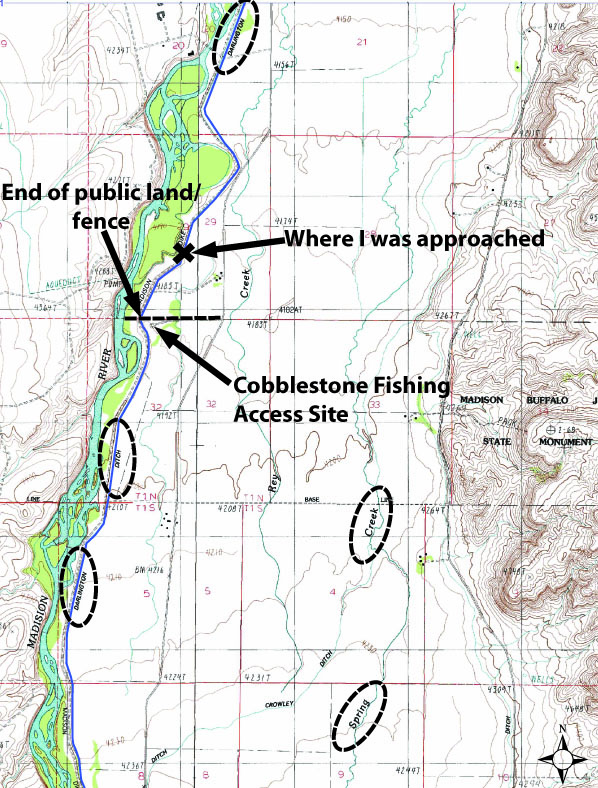
I suspected I was in for a large dose of rubbish as the gray Ford Explorer pulled up along the levee.
"Do you know where you are?" the man asked.
"Darlington Ditch," I responded.
"No, this is not Darlington Ditch. This is Spring Creek."
"Really."
"Yes. And you are trespassing. This is the Rice Ranch."
"No, I'm not. I'm within the high-water mark on a natural waterway."
"Did you cross that fence with the signs?"
"Yes."
"Then you are trespassing."
"No, I'm not. I have stayed within the high-water mark at all points. I know I'm on private property, but I have a right to be here."
"On the river, that's how it works (pointing to the nearby Madison River). But not here."
"Is this a natural waterway?"
"Partly."
...(standoff)...
"Look sir, I will get outta here, but I am not trespassing."
"That's all I ask."
Click to enlarge
It might be easier to let it go, but then ignorant harassers win. I knew I had a right to be there, it was obvious that I was in fact on Darlington Ditch as it was named on a sign just upstream (which didn't ultimately matter - anglers have a right to be there no matter what it's called), but he wasn't about to let it go. The Rice Ranch will be getting a letter from me explaining: that that particular creek is Darlington Ditch; the Montana stream access law; the fishing regulations on Darlington; and that I will see them again soon. I will be back with cell phone in hand, and will get Gallatin County's finest involved if necessary.

The creek itself is intriguing. The vast majority of the water is about 6 inches deep, with a slot here and there that gets to about 2.5 feet deep. It's very mucky in places (I fell through some ice into waist-deep black-tar sludge), and very weedy in true spring-creek fashion. There are a few tailouts, but eventually it turns into a slow, placid, featureless lake. There is a nice blurb about Darlington Ditch in the current Montana Sporting Journal in the "Spring Creek Tour" article.


Wednesday, November 24, 2010

Montana's brookies

Brook trout aren't typically thought of as being terribly ferocious. Voracious, to be sure, but not aggressive per se. They'll collect as many mayflies and midges as their stomachs will hold, but streamers aren't generally used when targeting them. But over the past year, I've learned that they can be quite predatory and will hammer streamers as much or more than brown trout in many situations.
In Montana, most of the best brookie water is kept under wraps. I can tell you a dozen places where rookies could have a good day with small ones, but big brookies are hard to find.
The best place that I know of (that's not a secret) for big brook trout is Georgetown Lake. I've never fished it myself, but I've heard reports recently that they're back with a vengeance (it has suffered in the past 10 to years, apparently due to whirling disease).
Check out this video from Blackfoot River Outfitters (the brook trout action is from about 1:10 to 1:50):


The biggest brookie that Montana Fish Wildlife and Parks has surveyed there was about 20.5 inches in 2006. In 2007, about 60,000 4-inchers were stocked and in 2008,another 50,000 er so were added. By 2011, the population should be thinned out a touch, but their lengths should be getting up there. It might be a great year to investigate the brook trout bounty at Georgetown Lake.

Monday, October 11, 2010

Yesterday my life was filled with clouds

so we decided to give the Jefferson another shot as conditions were ideal for a river that is basically a streamer show - clouds and rain, October, brown-trout river. Alas, it was a bust. We boated a couple dinks. Hooked a big rainbow, but only for a few seconds.
I went for a bike ride today, and as anglers are wont to do, gave every water I passed by the once over. I indeed found a couple ponds that were chock full of sunnies, bass and carp. The sunnies were feasting on midges as well as any trout I've seen, and the carp were eating something on top occasionally and plowing their snouts through the bottom when not rising. I will get back soon, with rod in hand.

To quasi-quote Dusty Springfield:
"The dark days are done
The bright days are here...

...Sunnies, one so true -
I found you."

Saturday, October 9, 2010

There's been a lot of talk...

timpanoga hecuba dun
...lately about the fall drake, aka hecuba, aka drake mackerel, aka red quill aka Snake drake. I've heard reports of them from the Big Hole, Yellowstone and Bitterroot rivers this fall.
I've only seen a good hatch once, on the Gallatin. It was a wet, cloudy late afternoon - September 10, 2008. No fish were rising so I didn't throw on a dry, but I probably should have. Hecubas are just shy of green drakes in stature, so it shouldn't take many to garner attention. They also have three short tails, and short stubby bodies like green drakes, so they're often confused for them. Their color is the main distinction, but season is another indication.
timpanoga hecuba nymph
They're a marvelous, beautiful, rare mayfly that are a treat to encounter. 
I think we're hearing and encountering so many more this year because of consecutive good-water years that provide the healthy rivers that certain rare bugs need to thrive. Check this out for more on that.
Should you see a hecuba, I'd recommend a big Royal Wulff or something similar. For more on drakes and Wulffs, pick up the upcoming issue of the Montana Sporting Journal
Go fish.